


What’s Up with the Mets? ⚾️
The Mets clobbered the Yankees on Saturday afternoon, taking Game 2 of the September Subway Series handily, 12-2 (box)
LHP Zac Thornton was excellent in his Subway Series debut, allowing just two runs on five hits over seven strong innings; he issued four strikeouts (including one to Aaron Judge on a 95.5 mph heater) against just one walk, and gave up a homer to Cody Bellinger
SS Francisco Lindor had a monster day, smashing two homers (leadoff, grand slam) and driving in five runs in his three-hit performance
The Mets hit six homers, three of them off starter Gerrit Cole (who now owns a career 7.28 ERA against them); LF Juan Soto, RH Carson Benge, C Luis Torrens, and 1B Jared Young all cleared the fence
Five Mets had multi-hit days, with Soto and Torrens each contributing a double alongside their homers
RHP Tobias Myers was solid in relief, allowing two hits with two strikeouts in two scoreless innings
Plays of the Game ⭐️
On July 10, 1999, the Yankees hit six home runs at Shea Stadium. Yesterday, the Mets finally returned the favor.
The homer parade started with Francisco Lindor’s leadoff homer. Luis Torrens followed in the second, and then Carson Benge in the third. After a four-inning break, the Mets got back into rhythm, with Juan Soto homering in the top of the seventh, Lindor again in the eighth, and finally Jared Young in the ninth to put the cherry on top of a particularly sweet sundae (…Saturday…?)
The Just Mets Podcast 🎙️
SUBSCRIBE: YouTube | Apple Podcasts | Spotify
Down on the Farm 🌾
2B Émilien Pitre (No. 10 prospect, Triple-A): 2-for-4, 2 R, RBI, BB, K
RF MJ Melendez (Triple-A): 2-for-5, 2 HR, 2 R, 3 RBI, K
1B Billy Amick (Triple-A): 1-for-5, HR, 2 RBI, K
RHP Bryce Conley (Double-A): 2.2 IP, 1 H, 0 R, 0 BB, 5 K
BOX SCORES
Double-A BNG | Triple-A SYR
Today’s Game 🗓
Match-up: Mets (69-79) at Yankees (85-63)
Where: Yankee Stadium - Bronx, NY
Starters: RHP Christian Scott (4-4, 3.81 ERA) vs. RHP Cam Schlittler (13-6, 2.01 ERA)
When: 1:35 PM EDT
Where to Watch: SNY
Zac Thornton has been the apple of Andy Green’s eye ✍️
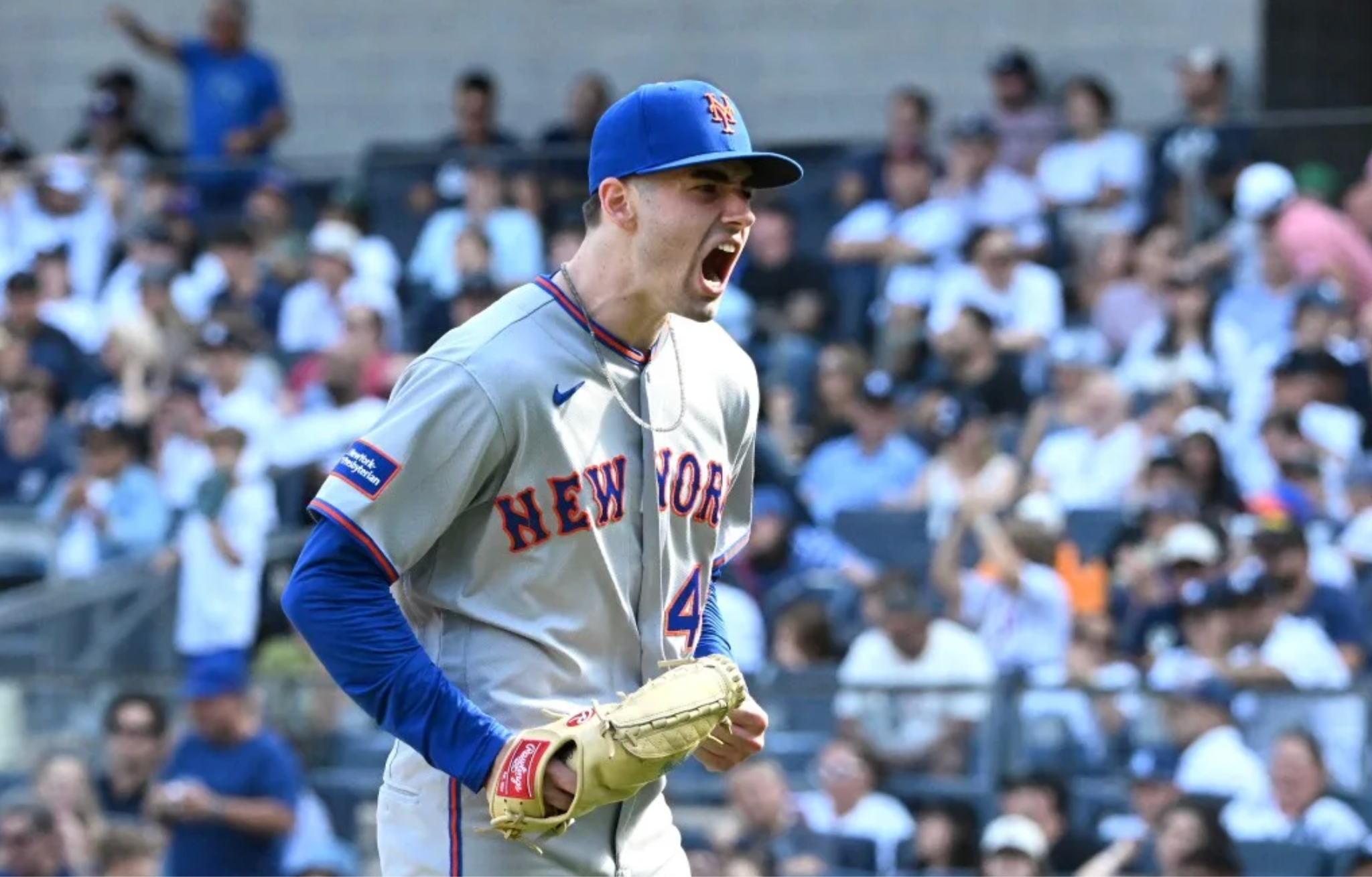
With yesterday’s start against the crosstown rivals, Zac Thornton seems to have all only further solidified his case to play a big role in the Mets’ 2027 rotation.
Yesterday, the young lefty epitomized the model of efficiency that he established himself to be in the minors: a 75% strike rate (61/81), less than 12 pitches per inning (P/IP; MLB average is roughly 16 P/IP), steadily increasing velo thrown for strikes, and a 43% chase rate with eight whiffs. Talk about a quality start.
Thornton has been the apple of skipper Andy Green’s eye for quite a while, and he’s made good on that faith just about every time he’s taken the hill. Since his permanent call-up on July 12, Thornton’s worked a 3.38 ERA over 56.0 innings, standing 85% of acquired runners and walking just 12 of 225 total batters faced in that span.
Though his numbers aren’t the flashiest, Thornton offers quite a bit to like in a pitcher profile, and while there’s obviously room for improvement, there’s also ample reason to believe this guy is a true diamond in some already pretty refined rough.
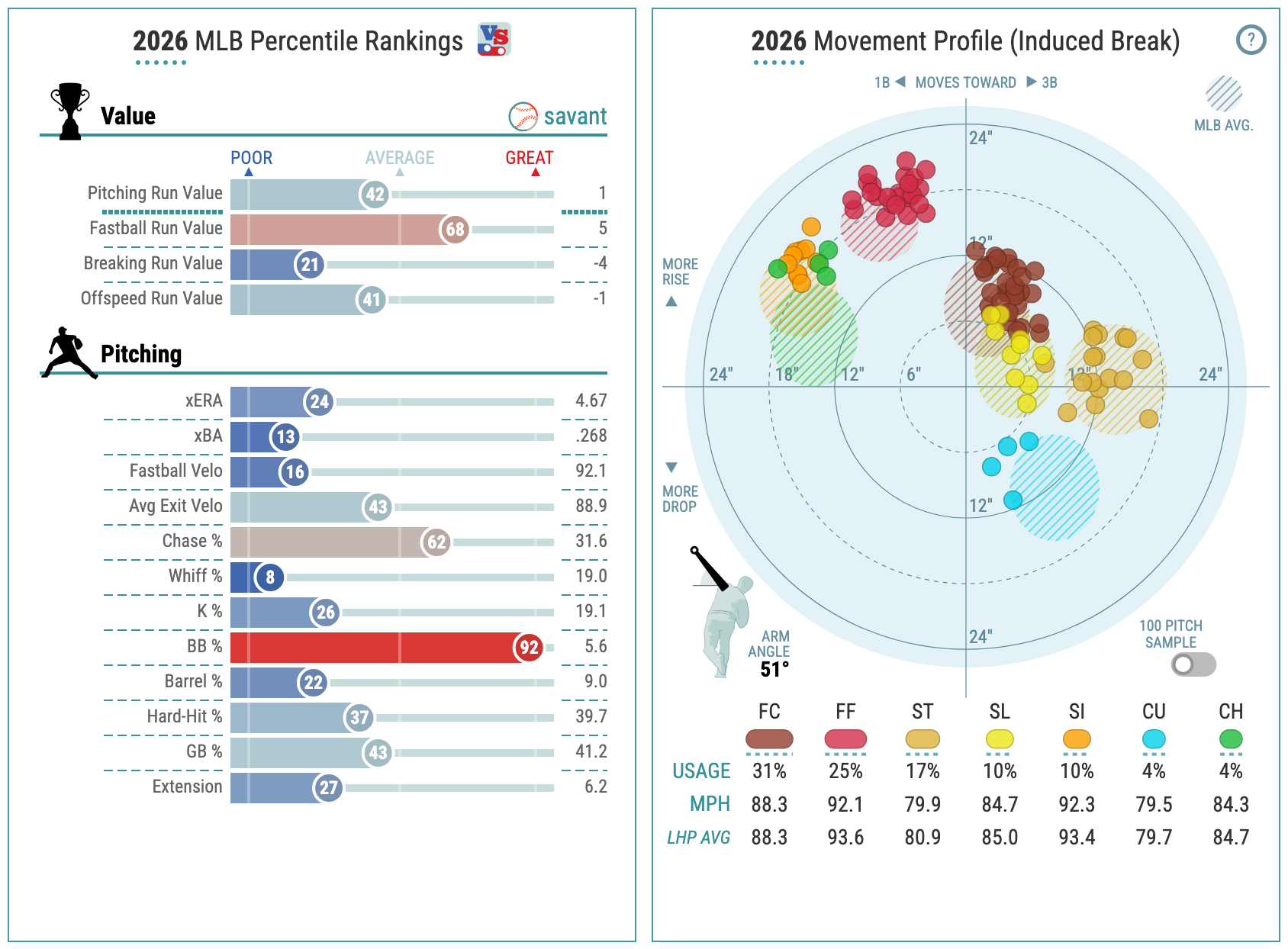
Don’t let all that blue fool you: this is a plenty effective pitcher.
See all those pitch types Thornton employs? While his fastball and slider reign supreme by a long shot, he’s still managed to throw all seven shapes for multiple strikeouts apiece, despite a sub-20% overall K rate. He’s proven to be adept at filling up the zone with his entire repertoire, which has helped lead to some of the lowest walk and WHIP numbers of his professional career, regardless of talent level.
By Fielding Independent Pitching (FIP), Thornton has been just about the same pitcher in MLB as he was in the minors. Over 62.2 minor-league innings in 2026, Thornton posted a 4.46 FIP; over 66.0 big-league innings, he’s got a 4.49. He’s striking out fewer guys, but walking vastly fewer as well; he’s allowing more homers, but also allowing fewer baserunners overall and leaving far more of them hanging on base whenever they do reach. Somehow, through it all, statistically, he’s remained largely neutral.
It’s very encouraging to see a young pitcher quickly adapt to the highest talent level in the sport; for it to have happened so quickly and for him to continue finding ways to contribute to wins is a serious testament to his makeup as a baseball player.
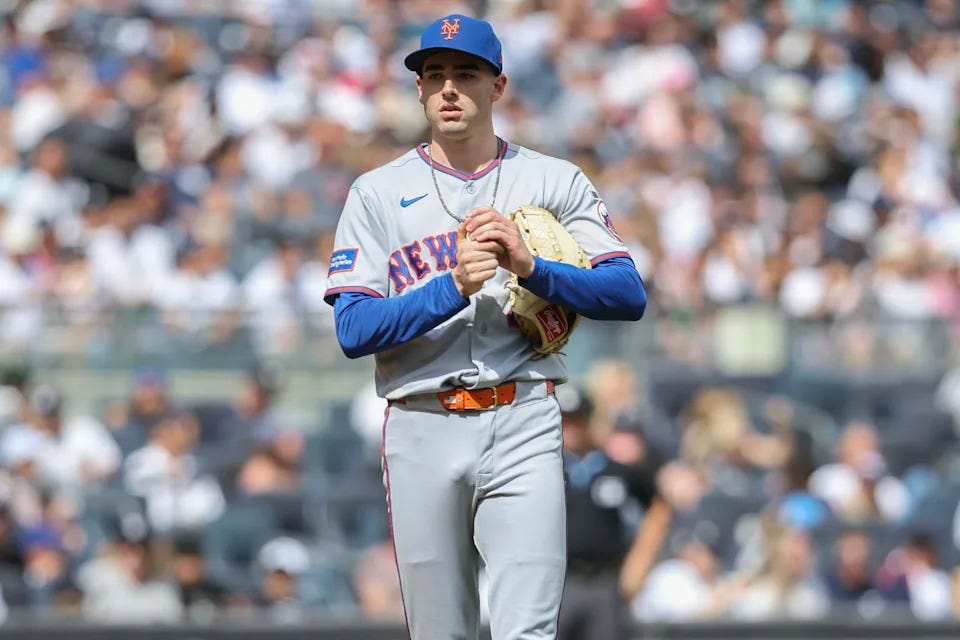
Now, there are some obvious sore spots in Thornton’s stat line that could get even more troublesome if not curbed early, chiefly in the batted-ball department.
While Thornton’s ERA on the season sits at 3.44, remember his FIP is a far less attractive 4.49. For the uninitiated, FIP uses only a pitcher’s strikeouts, walks, hit-by-pitches, and home runs — in other words, what they have direct control over, so no batted-ball results on balls hit into the field of play. Home runs are the heaviest influencer of FIP, and Thornton’s most glaring area for improvement is in the long ball.
Since he employs a style of pitching that naturally leads to a high number of batted-ball events (overall 82.5% contact rate in 2026), it’s not unreasonable to consider those events getting increasingly more damaging as the league adjusts to his stuff. Thornton’s current homer per fly ball (HR/FB) rate is the highest it’s been at any point in his young career; his 15.7% HR/FB is the ninth-highest in all of baseball. It’s not entirely surprising to see that number jump up for a rookie, but as he continues to boost his average fastball velo (vFA), he’ll need to learn exactly where and when to deploy it most effectively. His barrel rate on fastballs (15%) is very high, and that can quickly lead to trouble.
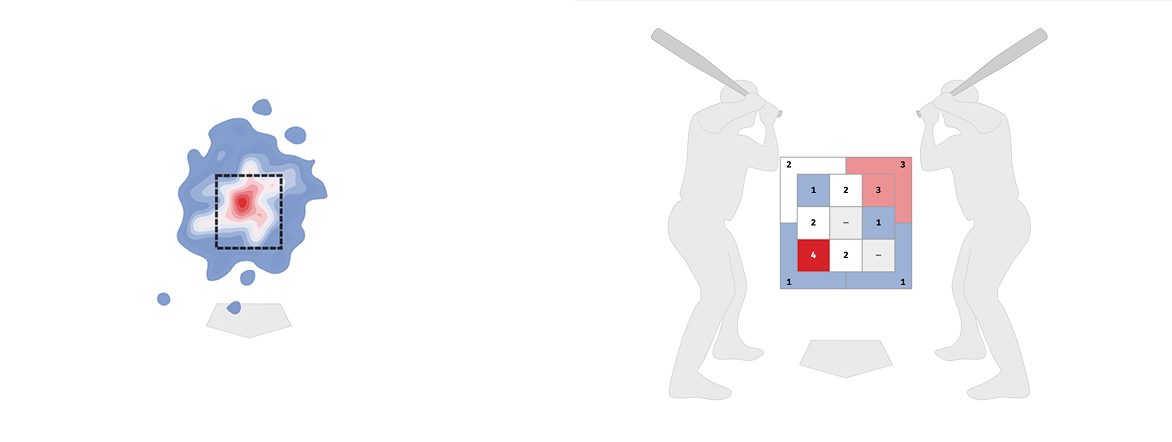
The chart above shows Thornton’s current fastball heatmap (L) alongside where he’s gotten his strikeouts with it so far this season (R). Unsurprisingly, when he’s working the corners and edges of the zone is when he finds the most success with his heater. Though you love to see the confidence of a guy ripping his best stuff down the middle — especially when he’s blowing it past Aaron Judge without a swing — it’s also easy enough to forecast how this pitch can become a problem if he doesn’t figure out how to use it most effectively as frequently as possible.
But for now, the current on-field results speak for themselves. With a sub-3.50 ERA through his first 13 major league starts, Thornton hasn’t just proved he’s an MLB-caliber pitcher — he looks increasingly like the type of stalwart rotation anchor the Mets needed to fill David Peterson’s since-departed shoes. He’s developing his repertoire alongside budding, sustained velocity while maintaining the MiLB baseline that got him to the bigs. There’s not much more you can ask of a rookie.
Thornton’s ceiling feels really high. In a way, the same can be said for this Mets team lately.
In a way, Thornton fully represents the Mets’ second-half turnaround and, at a minimum, appears to be filling a big hole in a big way the Mets once clearly needed to fill this coming winter.
Around the League 🚩
Ronald Acuña Jr. went three-for-three with a homer in the Braves’ 12-2 win over the Phillies; he’s hitting .378 with four homers and a 1.184 OPS in 12 games against Philly this season (MLB.com)
Rays lefty Ian Seymour racked up 10 strikeouts while allowing just two runs over six innings of work in a 3-2 win over the Astros
Nationals youngsters CJ Abrams and James Wood became the 11th pair of teammates in MLB history to record 30 homers and 20 steals in the same season
Red Sox southpaw Ranger Suarez tossed his second-straight gem, a seven-inning one-run performance against the Royals
The Cubs moved ahead of the Phillies to claim the top NL Wild Card spot with a 4-3 win over the Pirates
A great analysis as always, Drew. Thornton has got work to do but he is promising.
And Cole is the modern version of Clemens. The Mets own him!