


What’s up with the Mets? 🍎
The Mets signed INF Bo Bichette to a three-year, $126 million with opt outs after years one and two (story)
The Mets originally met with Bichette during the GM Meetings, and had a follow up meeting with him earlier this week, as they were unsure if they could sign OF Kyle Tucker (Athletic)
The Phillies thought they had a seven-year, $200 million deal nearly agreed to with Bichette on Thursday night (USA Today)
The Mets remain engaged on Cody Bellinger’s free agency (SI)
The Mets are showing interest in re-signing RHP Griffin Canning (NY Post)
The Mets signed 26 international free agents (Official)
Roster Moves 📰
Claimed INF Tsung-Che Cheng off waivers from the Rays
Rumor Mill 💨
The Yankees are willing to add opt-outs to their proposal to OF Cody Bellinger (NY Post)
The White Sox are showing interest in OF Michael Conforto (NY Post)
The Red Sox could consider trading from their starting rotation (MassLive)
The Orioles are among several teams showing interest in RHP Justin Verlander (Athletic)
The Reds are receiving trade interest in their starting pitching (Athletic)
In the latest edition of the Just Mets Podcast, Rich and Andrew discussed the club signing INF Bo Bichette on Friday morning, as well as what might be next for the Mets.
SUBSCRIBE TO THE PODCAST: YouTube | Apple Podcasts | Spotify
A bad day that quickly turned good in a whirlwind for the Mets ✍️
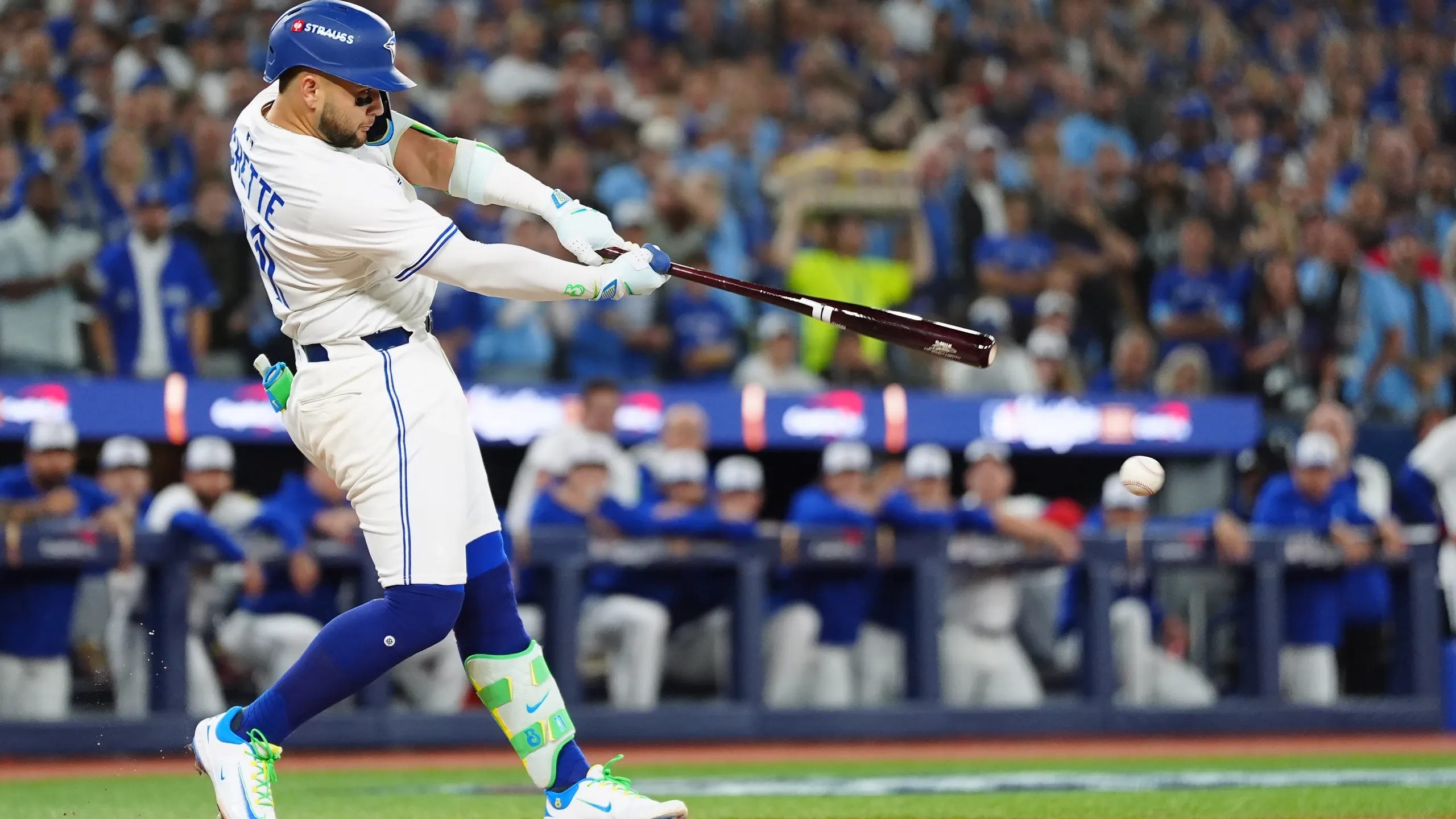
That was quite the 12-hour whirlwind for the Mets between Thursday night and Friday morning.
But, just so we are clear, the Mets signed a career shortstop in Bo Bichette to play third base, a position he has never played in his career. They’re going to move Brett Baty, a career third baseman, out of that position and have him be a utility player, inclusive of left field and quite possibly first base. They also signed Jorge Polanco, a career middle infielder, to play first base, a position he has never played before.
Meet the Mets infield.
12 hours earlier, the Mets lost their bid for Kyle Tucker after offering four years and a whopping $220 million to the Dodgers and an even more absurd four-year, $240 million contract. And at the same time, Bichette was apparently close to signing with the heavily favored Phillies for seven years and $200 million before the Mets landed him for half the term but for $14 million more per year and opt-outs.
Are you following? The Dodgers beat the Mets for Tucker, who beat the Phillies for Bichette.
The Mets are 1-for-2 against the Dodgers this winter.
It was certainly an interesting path for the Mets to land on Bichette, who really wasn’t at all connected to the Mets throughout the off-season but nonetheless was in the shadows. After the Mets acquired Marcus Semien, there didn’t seem to be a natural fit for Bichette, who always seemed destined for second base after evolving into a below-average shortstop with Toronto. They reportedly had several meetings with him dating all the way back to the GM Meetings in early November and as recently as earlier this week, per The Athletic.
This by no means is a natural fit for either Bichette or the Mets. They now have to make a wholesale change to their already questionable infield defense and make it more questionable. But, there’s a lot to like about this signing, and it’s arguably a better fit for the Mets than Tucker would have been for $14 million a year or so less. That doesn’t mean Bichette is better than Tucker - but being a better fit can be independent of that.
The Mets needed to find right-handed power. Whether they had signed Tucker or not, whether they ultimately sign Cody Bellinger or not, the departure of Pete Alonso left the Mets not only with a power void, but a power void from the right side which most teams are coveting these days but are finding it challenging to procure. That is in part why it’s hard to truly understand why this Mets front office didn’t value Alonso very much, especially when the Mets are going into the season with what can only be described as a mystery at-best at first base and not a certain upgrade defensively at the position.
At any rate, Bichette answers the call as a rare, elite bat from the right side. He’s a superb contact hitter who hits for power as well. No, it’s not Alonso-type power, but it is Tucker-type power in large measure with arguably better bat-to-ball skills and an elite eye, but from the right side and for a fraction of the price Tucker was.
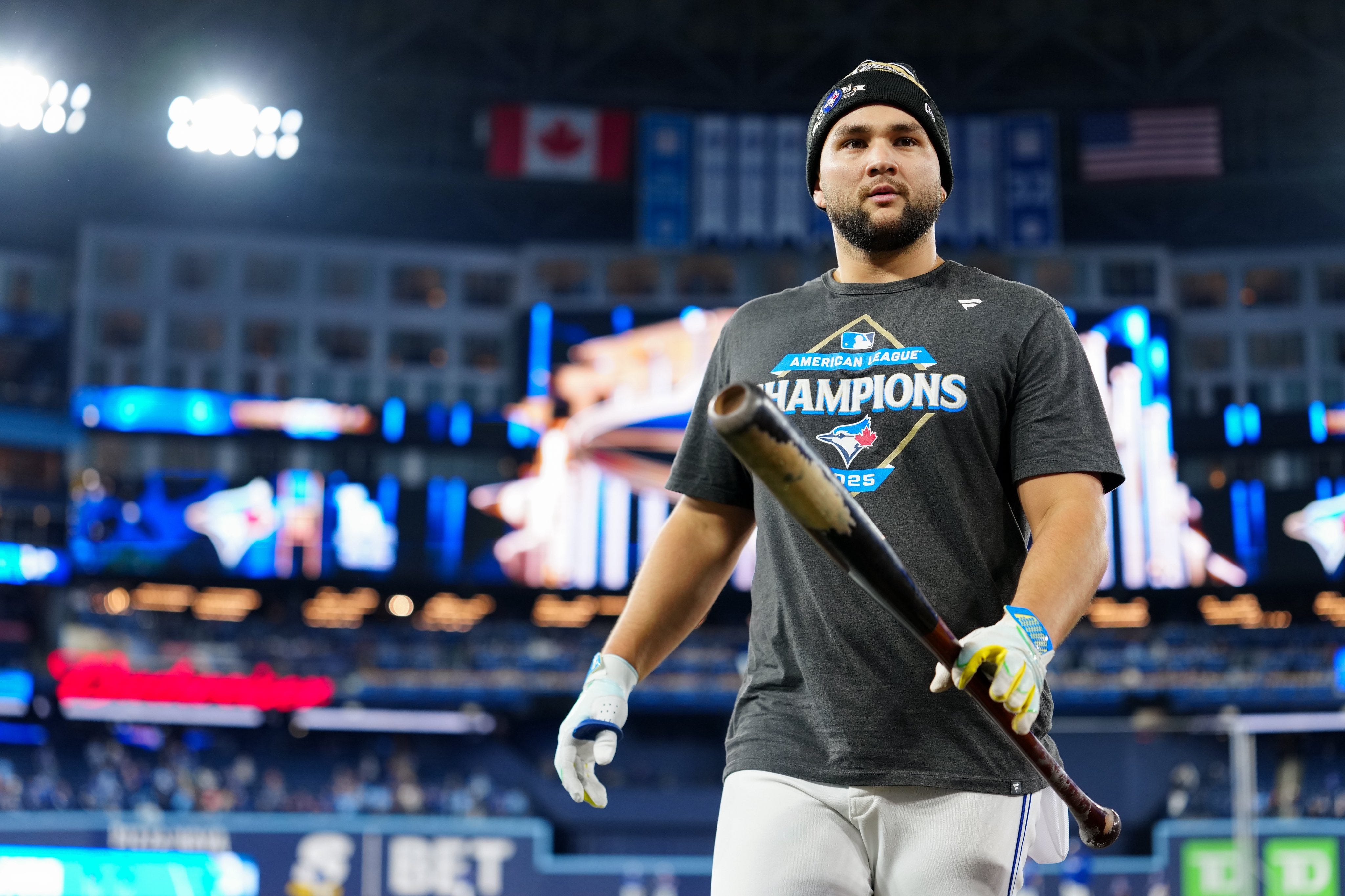
The Mets faced a similar problem defensively with Tucker as they do with Bichette, had they been able to win the bidding war for him over the Dodgers. Tucker is a right fielder, but so is Juan Soto, albeit an inferior defensive player to Tucker. As such, one of those players would’ve had to move to left field in that scenario.
In either case, the decision to pursue both players didn’t seem to be about run prevention as much as it was simply trying to sign the best player available to them. They clearly felt it okay to bring in the bat, bring in the personality, and figure out the defensive puzzle later.
That’s not necessarily a good thing defensively, especially since they’ve harped so much on fixing the defense, something David Stearns told reporters earlier this week was viewed as a key problem for them among rival executives in 2025. But I also don’t think Bichette is going to kill them at third, either. He couldn’t be much worse there than he was at shortstop in 2025 when he ranked the worst among all qualified shortstops with -13 outs above average, a -10 fielding run value, and -12 defensive runs saved. That was still largely good enough to help the Blue Jays win the American League East, primarily because of his and his teammates’ offense combined with a very strong pitching staff.
And that’s the key. The Mets can blame the defense all they want for their failure in 2025. To an extent, that blame is warranted, but not entirely. Their pitching was awful, specifically their starting pitching for the better part of 90 games. That combined with that defense is what led to their demise, but it was mostly the pitching, and that’s just being fair.
I do think Bichette can conceivably be a better defensive player at third. His arm isn’t great, but his range wasn’t great specifically at shortstop, and that problem can be buried a bit at third since he doesn’t have to cover as much ground. That’s not to say it’s a guarantee by any means - again, the position is foreign to him. But the learning curve should be short for him. It’s the same side of the infield, he’s young, and he’s athletic. This could end up being the least of their problems, especially if he hits the way he’s supposed to hit and stays healthy.
Like I said yesterday, it would be unwise for the Mets to trade Baty unless there’s a package out there they can’t look away from that would include him. Bichette’s ability to opt out in November makes trading Baty today very, very risky, especially since he’s a plus defender at the position, and the Mets may need him there at times in 2026.
Now, this would apply had the Mets signed Tucker as well, but if you look at these changes from this perspective, it should give you some more comfort over the Mets heading into 2026, even though there’s more work to be done.

Again, there’s more than meets the eye here, especially with two of the players the Mets have gotten will be playing out of position, at least as of now. And the Mets still have a -3.2 fWAR gap to cover from last season. But if you’re a believer in fWAR projections, this should offer comfort and hope heading into 2026.
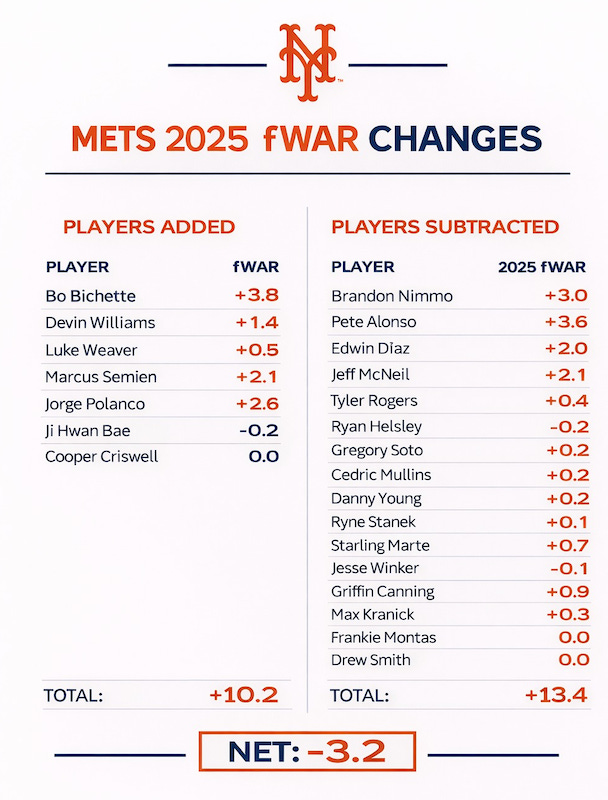
The general point is, losing out on Tucker and not having to pay that absurd sum for him might be a blessing in disguise after what has since transpired for the Mets.
So, what now?
Well, again, they still need pitching. But I have a feeling they’re going to be pursuing that resolution via a trade. Even though the Mets are getting a compensation pick for losing Edwin Díaz to the Dodgers, they’re relinquishing their second and fifth highest selections in the forthcoming draft for signing Bichette, who received and rejected a qualifying offer from the Blue Jays. If the Mets were to somehow sign Framber Valdez on the short-term deal they prefer, they’d be forced to give up two additional picks in the draft.
That just doesn’t seem like something this front office would want to do, at least not right now as they attempt to build a contending team, which is the primary difference between them and the Dodgers, as they already had a contender and an established pipeline to the big leagues, to say the least.
That doesn’t diminish their need for a front-line starter, or merely another starter. Literally all of them, from Nolan McLean on down, have questions, issues, or both shrouding them. It’s a unit which projects at 17th in fWAR in 2026, a unit which harshly failed them and sunk their 2025 season.
The obvious pursuits for the Mets are Freddy Peralta or perhaps Sandy Alcantara. But maybe there’s someone else they’re pursuing that we don’t even know about, as was the case with Bichette.
Then, of course, there’s the outfield, which still has a massive hole in left field.
The Mets have been linked to Bellinger on and off throughout the off-season, less so since they had been pursuing Tucker in recent weeks. But they’re still in, or perhaps back in on his free agency after losing out on Tucker, according to SI. He is still a great fit for this roster and probably a better fit than Tucker since Bellinger can play left field, center field, and first base, all of which are areas of need. A question remains whether or not he will ultimately leave the Yankees despite their reported impasse. He’s an even better fit for them in the end given their needs and park factor, which plays strongly in his favor. He is also not linked to draft pick compensation since he received a qualifying offer previously from the Cubs after the 2023 season.
So, it’s just money for Bellinger. But if Bellinger’s demands ultimately come down from the seven-year ask and into the five-year area the Yankees are reportedly willing to give him with the opt-outs, it would seem logical for Bellinger to take that and go back to a place he knows he can thrive.
Signing Bellinger can be that much more important for the Mets, if only because he would be installed in the outfield and offer stability at at least one position, on a team when so many players will be playing foreign positions for them in 2026.
Alternatively, the Mets could look for a shorter term deal for Eugenio Suárez, but he does not solve their outfield problem - he would come here as a full-time designated hitter with undeniable power from the right side.
We will see what’s next and how this all shakes out. But the Mets turned a bad day into a good day quickly on Friday, and might be better off despite the questions Bichette will come to New York with.
Around the League 🚩
The Twins are signing C Victor Caratini to a two-year contract (FanSided)
C JT Realmuto and the Phillies are in agreement on a three-year, $45 million contract (FanSided)
I see a lot of concern about the Mets new acquisitions playing a “new” position and I wonder how many baseball fans have ever actually played the game beyond maybe little league or slow pitch softball. I’ve been fortunate enough to be able play the game for decades now in competitive amateur leagues. No, I’m not a pro, but baseball is baseball and I’ve learned a few things along the way.
In my opinion and experience, most anyone that can play shortstop well is very capable of playing any of the other infield positions. Maybe not an an All-Star level initially, but I don’t think that’s entirely the point. Think of the Arod and Cal Ripken moves to 3B from SS for example.
Polanco (501 games) and Bichette (716 games) have been starting shortstops at the MLB level, so I have very little concern that they can play 1B and 3B respectively. This also gives the Mets tremendous positional flexibility in the infield for when someone needs a blow or inevitably goes down with an injury. Additionally the Mets still have more moves to make in the next few weeks. As we’ve seen, things can happen very quickly now that most of the biggest free agent names have come of the board. Bellinger is next and maybe he ends up with the Mets, who knows. Once he’s signed by either the Yanks or Mets, I believe that the trade market is about to open up and the Mets will make some moves there. We’ll see.
Are Vientos, Acuna and Mauricio afterthoughts? Or trade bait no team wants to bite on? Or depth, even with the next wave almost here?