


What’s up with the Mets? 🍎
ESPN’s Top 100 MLB prospects list features four Mets, all in the top 40 (ESPN)
Nolan McLean’s curveball ranks as the best among MLB’s top prospects (MLB)
The club agreed to sign INF Grae Kessinger to a minor league deal with an invite to major league camp this spring (SNY)
INF Bo Bichette will not play in the World Baseball Classic for Team Brazil (ESPN)
What I’m Reading 📰
The best and worst moves for the Mets so far this winter (NY Post)
David Stearns has rebounded from some curious off-season decisions (Newsday)
After early fan anger, David Stearns added big pieces to rebuild the Mets (NY Daily News)
The Mets are having a swell offseason (Fangraphs)
What I’m Watching 📺
David Stearns recently sat down with Mets team reporter Andy Martino to explain his off-season path and the plan ahead with Spring Training on the horizon:
SUBSCRIBE TO THE JUST METS PODCAST: YouTube | Apple Podcasts | Spotify
Freddy Peralta met with the media 🎙️
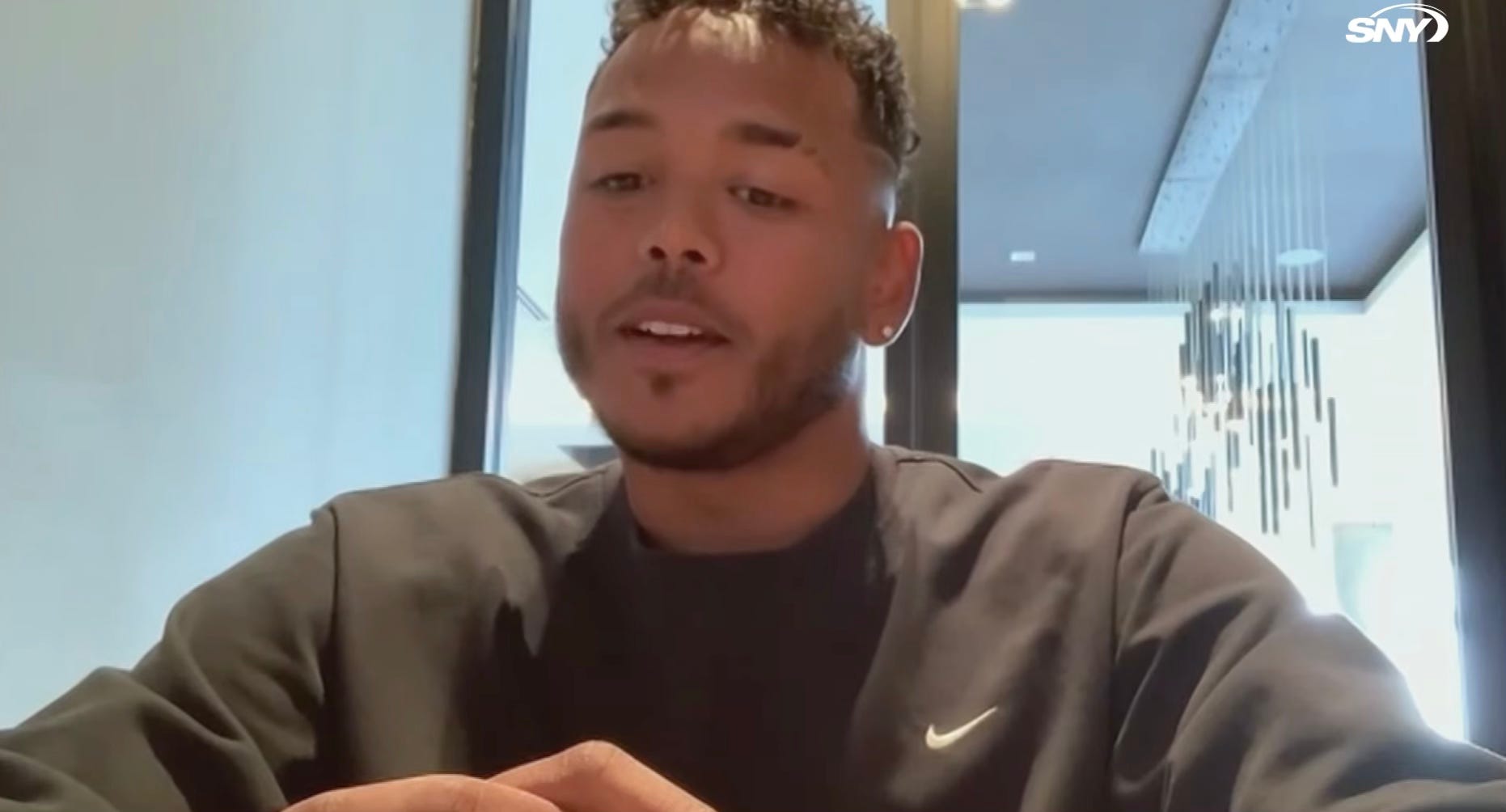
New Mets RHP Freddy Peralta met with the media for an introductory press conference on Tuesday afternoon and essentially said the following:
He’s looking forward to the competitive atmosphere that comes with playing in New York
He expressed that even he wasn’t immune to all the trade speculation, saying that he himself followed the rumors up until the decision was final
When asked about his leadership style, Peralta said he just tries to be himself every day, no matter where the team is at. He also said that he grew up always trying to boost people up and make sure people around him have a better day, and that he plans to bring the same energy to New York
Regarding the World Baseball Classic, Peralta said he hasn’t yet decided if he’ll be participating for ‘personal reasons,’ but that a decision will come soon and that representing their country is the best feeling a player can have
Speaking to last season’s rotation struggles, Peralta said that while he can’t guarantee he’ll change everything, he said he prides himself of working hard to be ready to go every five days
Peralta said he hasn’t yet spoken to everyone on the club, but he did talk to Francisco Lindor, Juan Soto, Tyrone Taylor, Sean Manaea, and Francisco Álvarez and expressed that can’t wait to have fun with everybody
On the topic of an extension, Peralta was non-committal, saying he wanted to get acclimated to his new team and environment before making any decisions
I’m really not that worried about the Mets’ infield defense ✍️
If there’s one thing Mets fans are accustomed to, it’s looming lineup anxiety.
It’s a pattern we see every offseason — no matter the signing or trade, this fanbase, scarred by years of seemingly relentless divine torment, is never quick to offer a blanket seal of approval on a roster move. Even when Juan Soto signed his enormous contract a year ago, it was met with some reproach (and continues to be).
Part of that is the fanbase never being satisfied too, for what its worth.
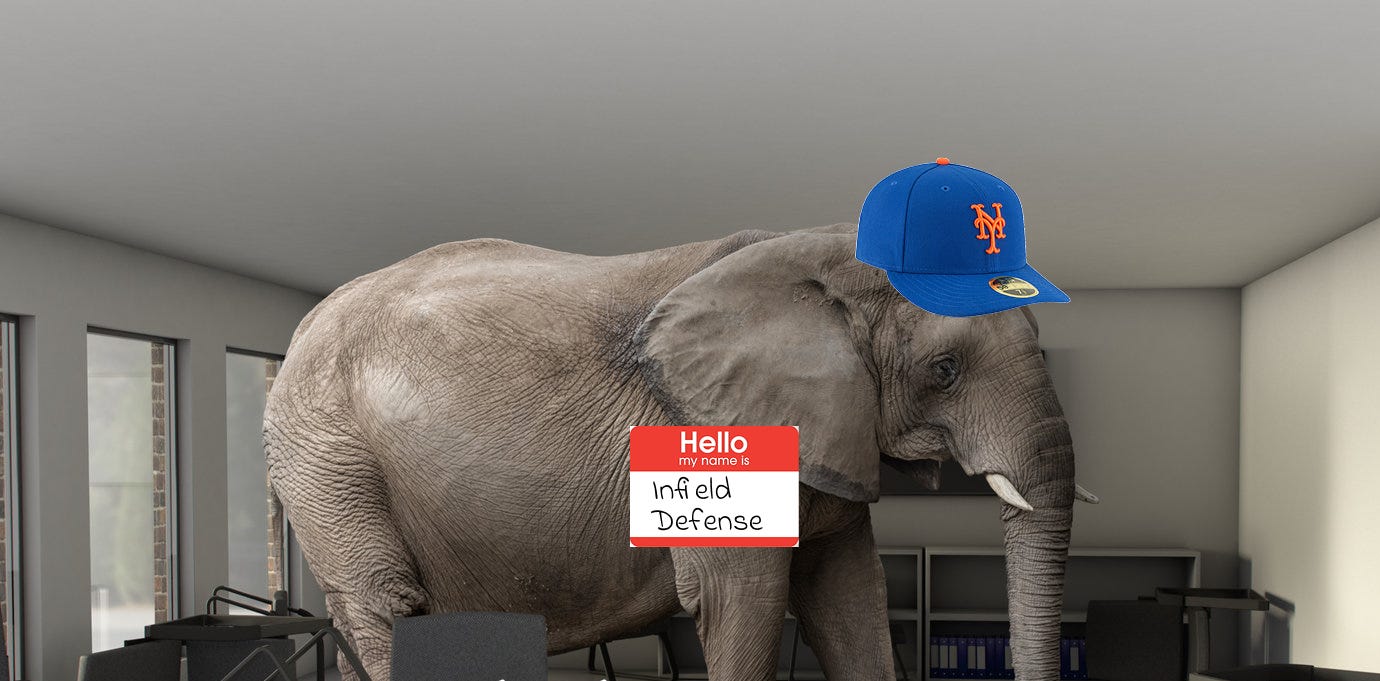
Yet this year, amid a series of nips and tucks that have changed both the cosmetics and chemistry of this Mets clubhouse, the response seems outsized to the level of outrage we’ve all become numb to. Franchise fixtures are no longer here, and their replacements haven’t exactly inspired as much confidence as one might think, largely because of a looming elephant that’s been danced around, but not deeply discussed.
That elephant’s name is ‘Infield Defense.’
The concern is valid enough: two of the team’s newest faces, Jorge Polanco and Bo Bichette, are being brought in to cover positions they’ve never played professionally at first and third base respectively. Factor in their lackluster defensive metrics at their primary middle infield positions, and the hesitant response of some Mets fans makes even more sense.
But here’s the thing…I’m not convinced there’s all that much for us to worry about.
Yes, these two players are learning new positions, but they’re two positions that, historically, have been ‘easier’ for players to pick up than say, shifting from a corner to a spot up the middle. In 2022, on the heels of the whirlwind Carlos Correa signing saga, Sports Info Solutions published a piece that looked at 12 players who moved from shortstop to third base from one season to the next. Though the results were mostly inconclusive amid a very small sample size (a semi-literal grain of salt, if you will), the data did determine that most of the transitions in question yielded neutral-to-positive results. Seven of the dozen qualified players improved or maintained their Runs Saved rate after moving to third – obviously as slight a majority as you could have in this context, but it’s enough to spur my own research forward.
So, picking up where the 2022 article left off, I pulled together a quick chart comparing the defensive performance of current and past Mets infielders from 2023-2025. I decided to look at five stats: Defensive Runs Saved (DRS), Plus/Minus Runs Saved Above Average (rPM), Outs Above Average (OAA), Fielding Run Value (FRV), and FanGraphs’ Def.
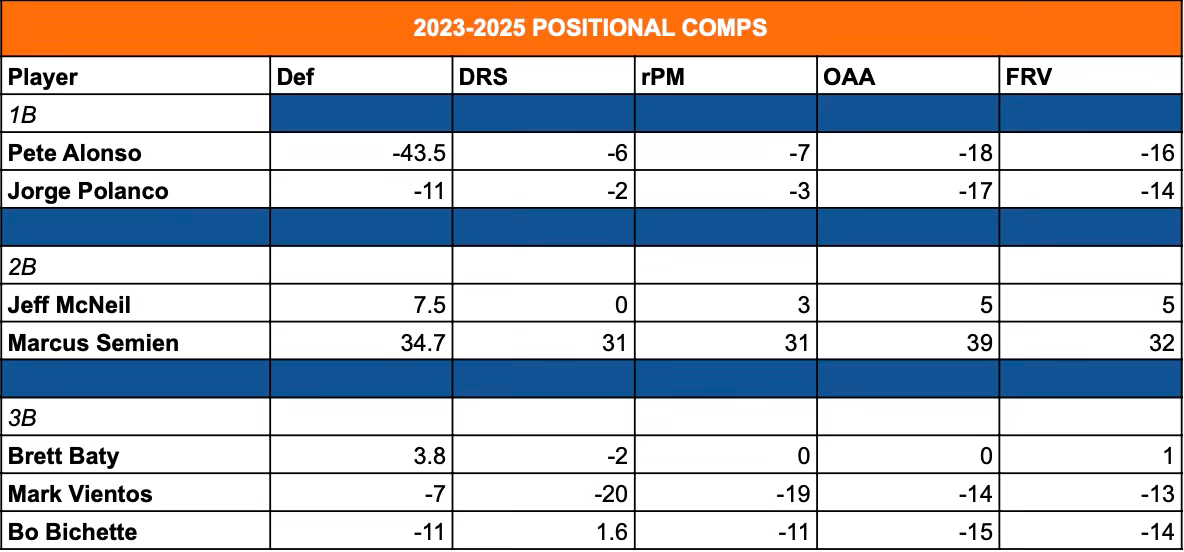
When analyzing defensive metrics, it’s important to remember that most of these numbers aren’t meant to be compared directly. DRS, OAA, and FRV are all position-relative; rPM is part of the DRS formula. These metrics measure how a player performs relative to others at the same position. In that sense, when looking at Jeff McNeil and Marcus Semien side by side, we’ve got an apples-to-apples statistical comparison. That defensive upgrade is self-explanatory.
Where those numbers can get misleading is when you try to assess player value across positions – hence, my inclusion of Def. When comparing players who mostly man two different roles in the field, you need to consider something called positional adjustment. This is a numerical factor that accounts for how demanding a position is overall; for example, a shortstop gets a larger adjustment than first base because out opportunities are more frequent and more difficult.
Fangraphs’ Def combines a player’s fielding runs with their position’s respective adjustment factor to produce a single, context-neutral number. Think OPS+, but for defense: zero (0) Def is league-average no matter where you play, and -10 Def means the same thing for a first baseman as it does for a shortstop.
This is where the Jorge Polanco first base experiment starts to look less scary.
If you were to compare their DRS, OAA, and FRV stats side by side, the move from Alonso to Polanco defensively looks like a net neutral one, one not worth making when you consider the loss of Alonso’s offensive firepower. However, the vast gap between their Def score over the last three seasons (Alonso’s -43.5 Def is the second-worst mark in all of MLB in that span) starts filling in some contextual blanks. Polanco’s decreasing numbers accurately reflect a decline in range at his position, which exacerbated already less-than-stellar numbers. However, Polanco’s new position is far less range dependent. Yes, it requires learning new coverages and ranging to his right for balls in the hole, but I’d argue that shifting to a position that’s relatively anchored on the diamond will end up raising Polanco’s defensive floor.
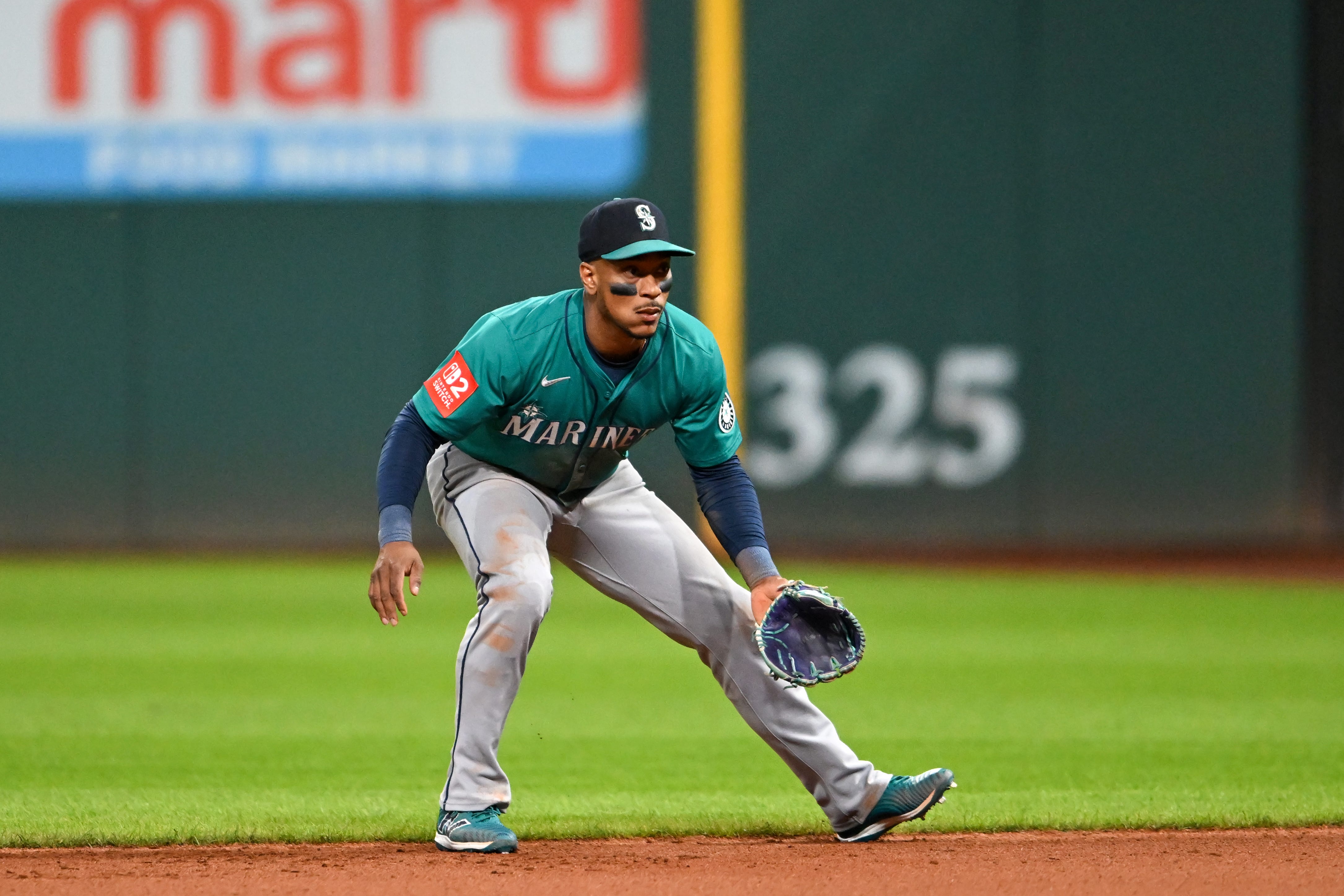
Additionally, he’s reportedly spent nearly a full season working at the position behind the scenes, Seattle just never needed to utilize the new skill set. Granted, there’s no replacement for in-game experience, but I think it’s fair to assume that the work he put in last year will help mitigate any bumps in the development road here. Ultimately, by the numbers, it would be difficult for Polanco to be a step down from Alonso defensively.
Okay, so DRS & Co. help us compare players at the same position, and Def helps us compare defenders en masse…let’s talk about what those numbers forecast say about Bo Bichette.
Looking at the chart above, you’ll notice that Bichette has graded out roughly the same defensively as Mark Vientos the last few years; both track significantly behind Brett Baty in this department, unsurprisingly. Bichette’s OAA and FRV from 2023–2025 sit in a comparable negative range, and his Def is four points lower, but he still posted positive DRS, showing he did manage to convert plays at a higher rate than Vientos. However, that silver lining only shines so bright, as losing the steadily-developing glove of Baty to utility duty certainly leaves the hot corner as a bit of a defensive question mark.
Still, I don’t think there’s a ton to worry about here. Bichette was signed first and foremost for his bat; as long as that plays, he’s doing his job. If he ends up being a largely lateral defensive move for a year, it’s not the end of the world. Even so, I do believe he’ll be one of slight majority reflected in the SIS article that ends up benefitting from the shift. What Bichette needs most is a position that complements his skill set more naturally than shortstop did, and if Carlos Mendoza’s recent comments are to be believed, I think shifting to his right will do exactly that.
So no, I don’t believe the Mets’ 2026 infield situation warrants the level of concern it’s been receiving. Call me crazy, but it feels like a bit much ado is being made about relative nothing.
The fixation on defense is no doubt partially the result of what was on full display in the second half of last season coupled with David Stearns’s ‘run prevention’ comments, but I won’t sit here and begrudge fans their rightful skepticism seeing half their team’s infield is comprised of ‘newbies’ at the positions. However, I feel confident we’re in for much less of a defensive disaster than some have suggested.
And don’t forget - the term ‘run prevention’ is not exclusive to a team’s defense. It includes pitching, that which was really bad after June 12 last year and the main reason why the Mets did not make the playoffs.
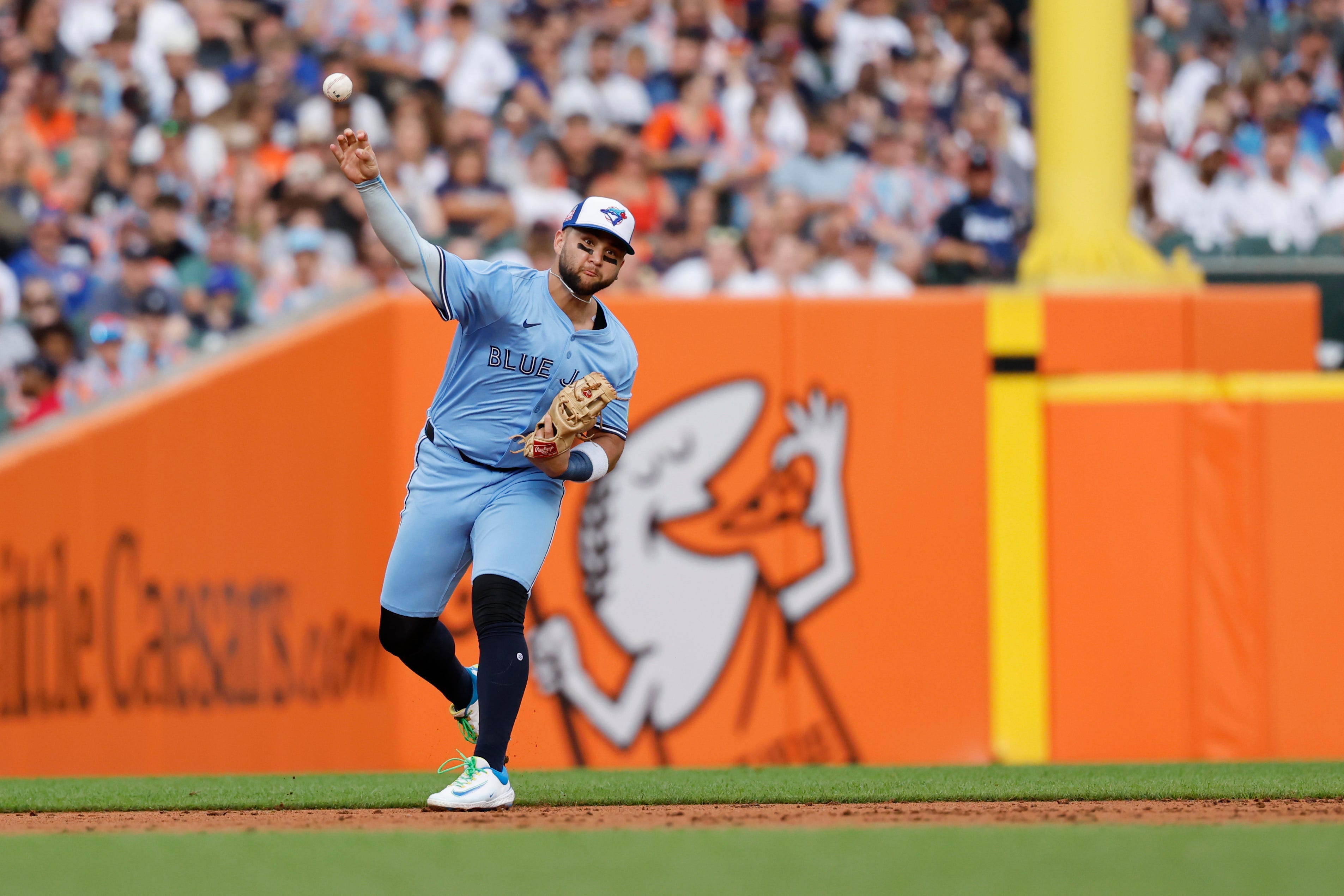
Polanco and Bichette are sliding into positions that naturally allow more room for growing pains than their previous roles, which is a best case scenario for both players — they don’t need to be elite in the field, just serviceable. With an up-the-middle defense led by Francisco Lindor, Marcus Semien, and Luis Robert Jr., plus support off the bench from Baty and Tyrone Taylor, this seems like a fairly safe risk for the front office to take.
Ultimately, it all comes down to preparation and execution. Baseball doesn’t exist solely on paper. But I think everyone can relax a little: the numbers tell a story that’s far less alarming than the current popular narrative would have you believe.
If anything, there’s hints of a net improvement over what the team had before.
Around the League 🚩
The Yankees claimed former Met RHP Dom Hamel off waivers from the Rangers
The Mariners acquired C Jhonny Pereda from the Twins for cash considerations (MLB)
Carlos Correa and Jose Altuve are skipping the WBC due to contractual hangups (CBS Sports)
Teams have been informed that this season’s trade deadline will be August 3rd (FanSided)
Hope you're right. "...semi-literal grain of salt...", another milestone in the annals of New York Mets punditry. And an elephant in the room is less threatening than a gorilla to some degree.
The Mets need to do more with their rotation. Peralta was a good move and we are all excited about McClean. Behind them it’s the same that got us nowhere last season. Stearns openly said we can’t count on 30 starts from Senga. How can we believe Manaea pitches a whole season as he did noting with whatever is wrong with his elbow. Petersen hit a wall when he was needed most. Holmes is a five and done guy. Believing a big bounce back here is foolish. I’d get Sevy back because he wants to be here. He was also training with Peralta by the way. I’d also again look at Quintana and Bassit. Both innings eaters who will give you a low 4 ERA. I’m sorry this roatation better not be done.