


In a regular season that was all but lost within its first few weeks, 2026 still treated fans to a glimpse of a brighter, not-too-distant future, thanks to the arrivals of Carson Benge, A.J. Ewing, and Zac Thornton alongside a full-season campaign from Nolan McLean. With the promotions of the best rookie class in franchise history, it’s understandable that the buzz around the Mets’ farm system since the dog days of summer ‘26 is arguably the loudest it’s ever been.
Jefferson Rojas. Émilien Pitre. Sammy Stafura. Billy Amick. Elian Peña. (Chris Suero.) Mets fans are likely well-acquainted with these names and others at the top of the team’s Top 30. But plenty has been written about those guys by now, and this past minor league season saw ample movement up and down the development pipeline throughout the system.
So today, we’re going to talk about five (arguably) under-the-radar players in the Mets’ system that I’m especially excited to watch in the coming year.
D’Andre Smith, OF/2B
(25 y/o, Triple-A)
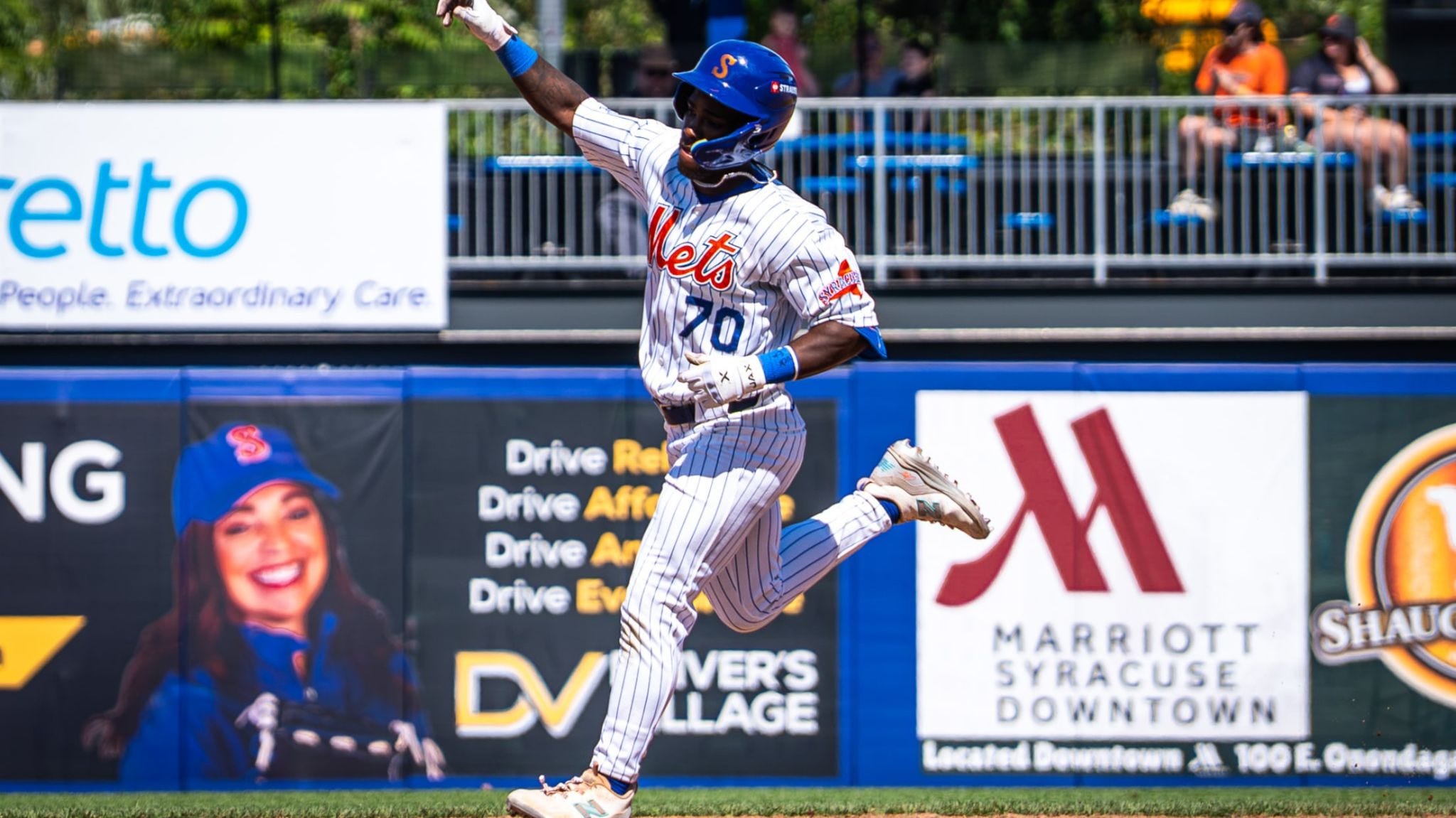
Though he’s been with the organization since the Mets took him out of USC in the fifth round of the 2022 draft, D’Andre Smith’s name is one that I admittedly wasn’t all that familiar with entering this year. In his final year with the Trojans, Smith hit .286/.380/.471 with eight home runs, and though that same level of production hasn’t shown up over the course of his amateur career to date, his short Syracuse stint to close out 2026 flashed plenty of what he has to offer.
Over 32 games with the Triple-A team, Smith hit .294/.389/.505 with six home runs and 12 stolen bases, good for a .398 wOBA and a 132 wRC+. His .211 isolated-power mark over that span reflected a significant jump in what has notably been a more latent part of his game — with a history of defensive flexibility (he covered four positions in 2026) and a burgeoning speed tool (20+ steals in ‘25 and ‘26), an uptick in power only makes him that much more valuable to a locker room that’s consistently skewing younger, faster, and peskier in all aspects of the game.
The question, of course, is whether Smith can maintain the changes that led to his power outburst upstate. The ability to steal bases and play anywhere in the field speaks for itself, but his career MiLB slash (.255/.325/.391, 23 HR, 8 3B, 69 SB) points towards a more contact-oriented approach. The thing is, he hits a lot of balls on the ground — for someone who pulls 40%+ of their batted balls, consistently elevating the ball is the key to making the most of that contact. If Smith can keep this particular bottle uncorked and flowing, next season could be the one that ultimately maps the course of his career.
Marco Vargas, SS/2B
(21 y/o, Double-A)
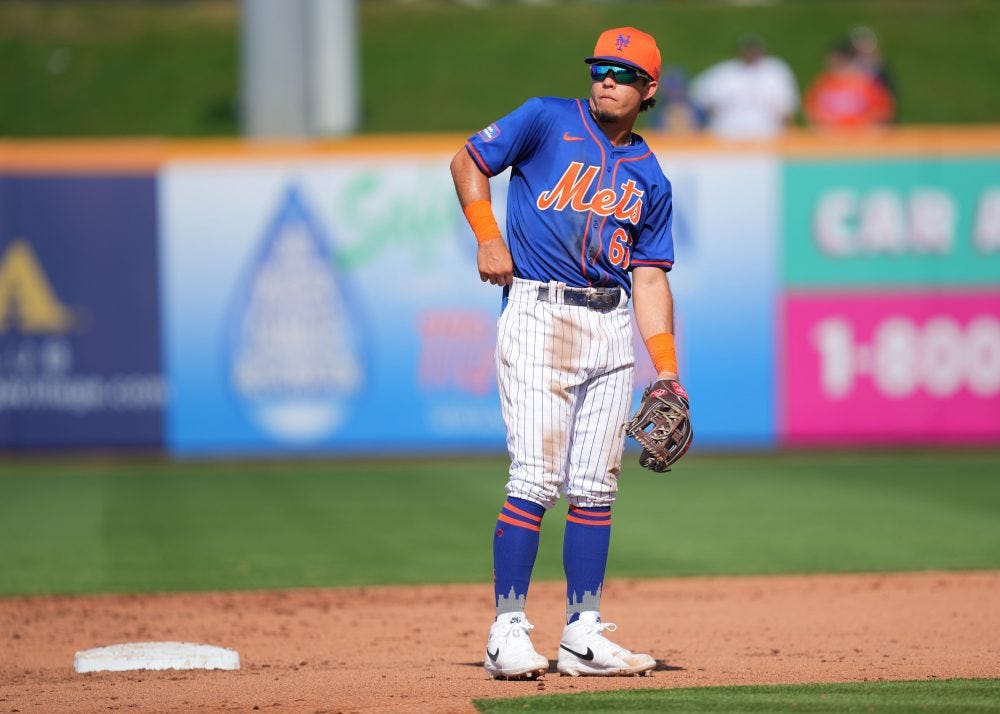
Originally signed by the Marlins as an international free agent in May 2022, Marco Vargas came to the Mets in July 2023 as part of the return for David Robertson, alongside catcher Ronald Hernandez. He was a well-regarded prospect upon his arrival in the org, with FanGraphs ranking him among the Marlins’ top 10 talents at the time. Since hitting just .208/.369/.238 in an injury-shortened 2024 season with St. Lucie, Vargas has spent the last two years demonstrating exactly what us nerds have seen in him all along.
In 2026, the 20-year-old hit .282/.363/.407 with three home runs and 28 stolen bases in 53 Double-A games, missing roughly two and a half months with an injury. Before going on the injured list, Vargas hit .210/.331/.290; after returning, he hit .349/.395/.514 over his final 27 games. That late-season stretch included three home runs and 16 steals, giving the Mets a welcome reminder of what Vargas can do when he’s healthy. His .403 BABIP is a clear reason not to take the batting average at face value, but the improved extra-base production is encouraging.
Vargas has long been an appealing defensive prospect, with the ability to play both middle-infield positions and enough speed to create opportunities on the bases. His 28 steals in 29 attempts last season at Double-A are proof positive of his ability to dominate the basepaths and maximize scoring opportunities; similarly, his 11.3% walk rate suggests that he has more of an ability to control the strike zone than he’s demonstrated to date. He cut his chase rate down significantly, but his overall contact rate went with it: Vargas struck out 68 times in 209 at-bats, so there’s still some work to do to fit all the pieces neatly together. Still, there have been enough sustained improvements at the plate in just the past calendar year that the franchise should feel confident in this particular talent.
Corey Collins, 1B/LF
(25 y/o, Double-A)
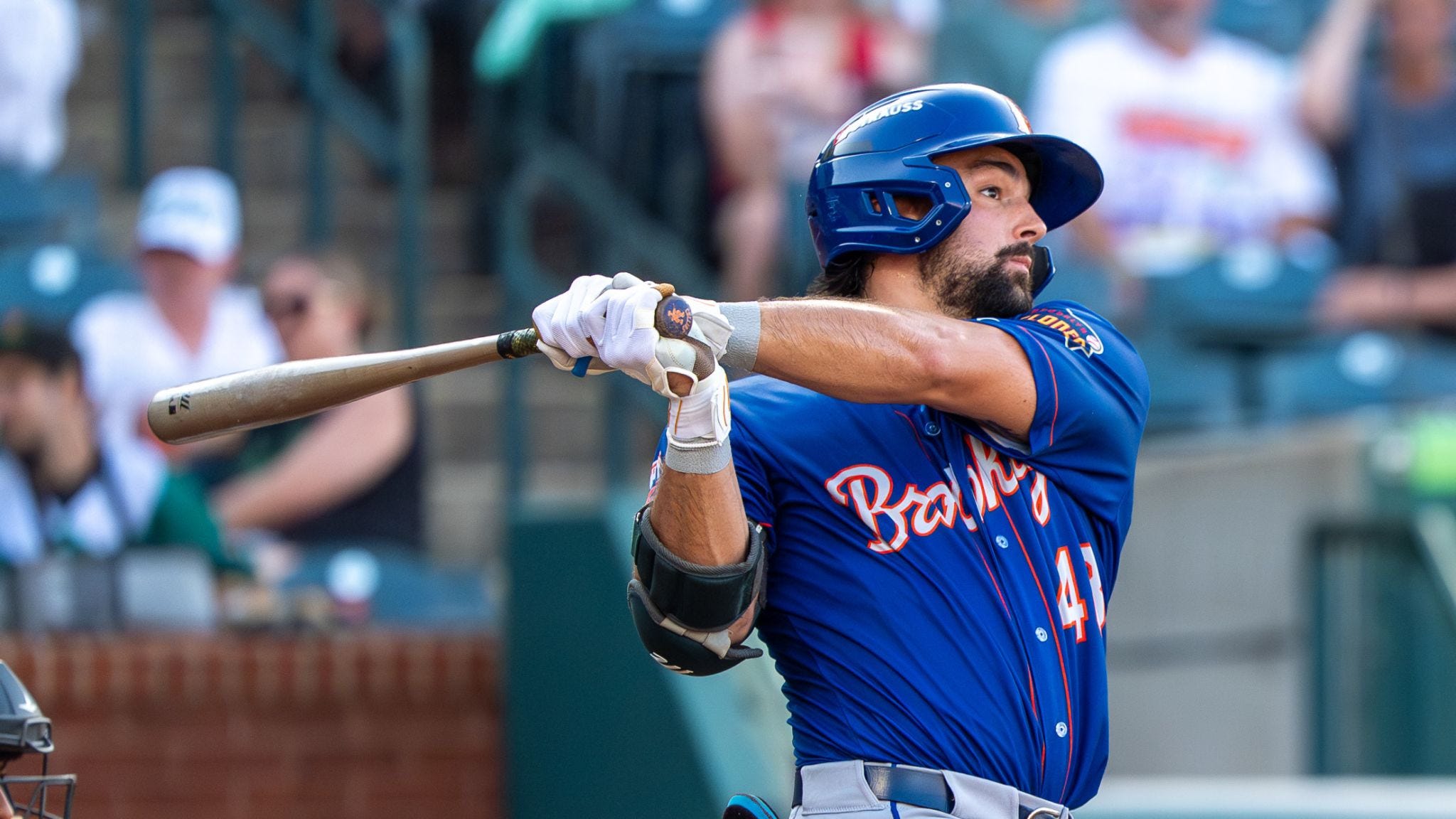
Like Smith, Corey Collins’ name is one that I was completely unfamiliar with entering this last season — I was educated quickly. There was a non-negligible stretch of time this season where it felt like I was seeing Collins’ name pop up in every single ‘Down of the Farm’ section of the newsletter I’d put together. That’s for good reason: Collins had one of the more promising offensive showings in the Mets’ system in 2026. The Mets selected Collins out of the University of Georgia in the sixth round of the 2024 Draft. The Bulldog broke out in his senior season, hitting .354/.574/.772 with 20 homers.
Over 111 games in 2026, Collins hit .238/.387/.446, totaling 18 home runs and 81 walks over 455 plate appearances for Brooklyn and Binghamton. Yes, that’s right: 81 walks in 455 trips to the dish, good for a 17.8% rate. That walk total powered a ridiculous .387 on-base clip despite Collins hitting below .240, the latter of which can largely be explained by a 27% K rate. The good news, though, is that he finished the year productively in Double-A, hitting .250/.380/.522 with 10 home runs in 43 games there, so it’s not like he fell off a cliff when the heat got turned up. As a matter of fact, his strikeout rate went down.
The next step for Collins is seeing whether he can make enough contact to turn that power and patience into a sustainable profile. The strikeouts are a legitimate concern, especially as he faces increasingly advanced pitching, but the combination of home run production and walks gives him a foundation worth developing. Collins is a first baseman and occasional corner outfielder, so his bat will have to do most of the work, but his base profile as a disciplined slugger should translate well across levels, as it’s already started to prove. A little more discipline in the box could help this guy go a long way.
Randy Guzman
(1B/3B/OF, 21 y/o, High-A)
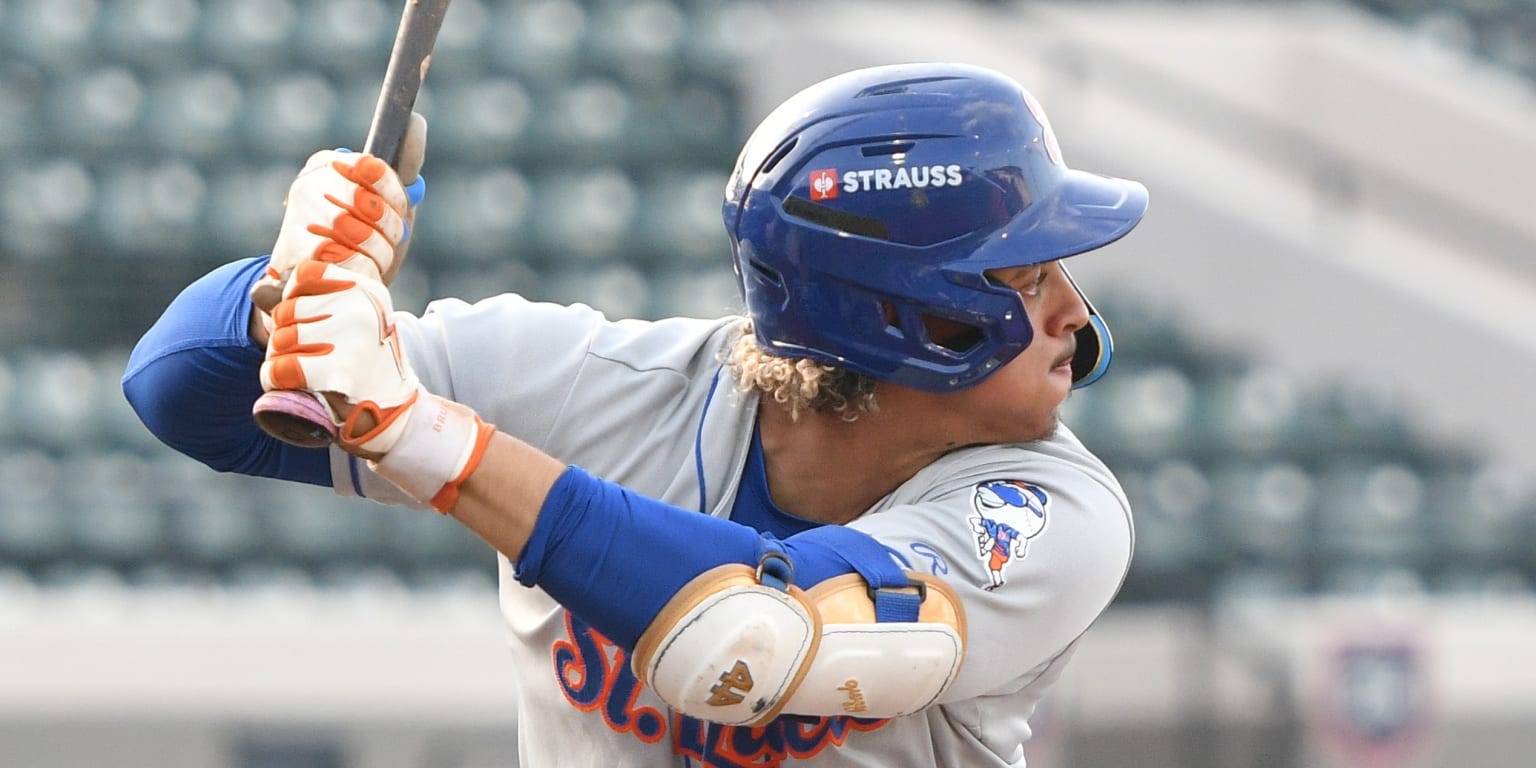
Randy Guzman is someone that I’d imagine even passive Mets prospect watchers have likely heard of. The Mets’ #21-ranked prospect (the only one of this batch currently in the Top 30) was a fun bat to follow this season, as he flew through three levels of the system from complex play to High-A. The Mets signed Guzman out of the Dominican Republic in September 2022 — in his time with the franchise, he’s compiled a 260/.359/.456 line with 28 homers and five triples across 214 minor league games. Not a bad return for what was reportedly just a $10,000 bonus.
This season, Guzman hit .274/.377/.514 with 12 home runs at Single-A St. Lucie before a brief stint in Brooklyn in which he went 7-for-16 before his season was ended prematurely by injury; he also missed six weeks in the summer due to a strained quad. While his season was limited to just 72 games, his .240 ISO mark at St. Lucie is particularly tantalizing, as are his 11.3% walk rate and increased stolen base productivity.
His scouting profile is what makes those numbers especially intriguing. Guzman has the strength to drive the ball a long way, and MLB Pipeline has graded his power as a 60 on the 20–80 scouting scale. His biggest issue lies in his approach — he loves to chase (34.4% in 2026), and there isn’t exactly a ton of contact coming with all the extra hacks; that’s extra maddening considering he’s swinging at more than half the pitches he sees (52.5%). He’s going to need to hit far more than 80% of pitches he sees in the zone for his bat to actually play on a big stage. However, the totality of the player package Guzman provides as a primary corner infielder with plus defense and developing speed is substantive enough for fans and franchise officials alike to buy some stock in his upside.
Trey Snyder, 2B/OF
(21 y/o, High-A)
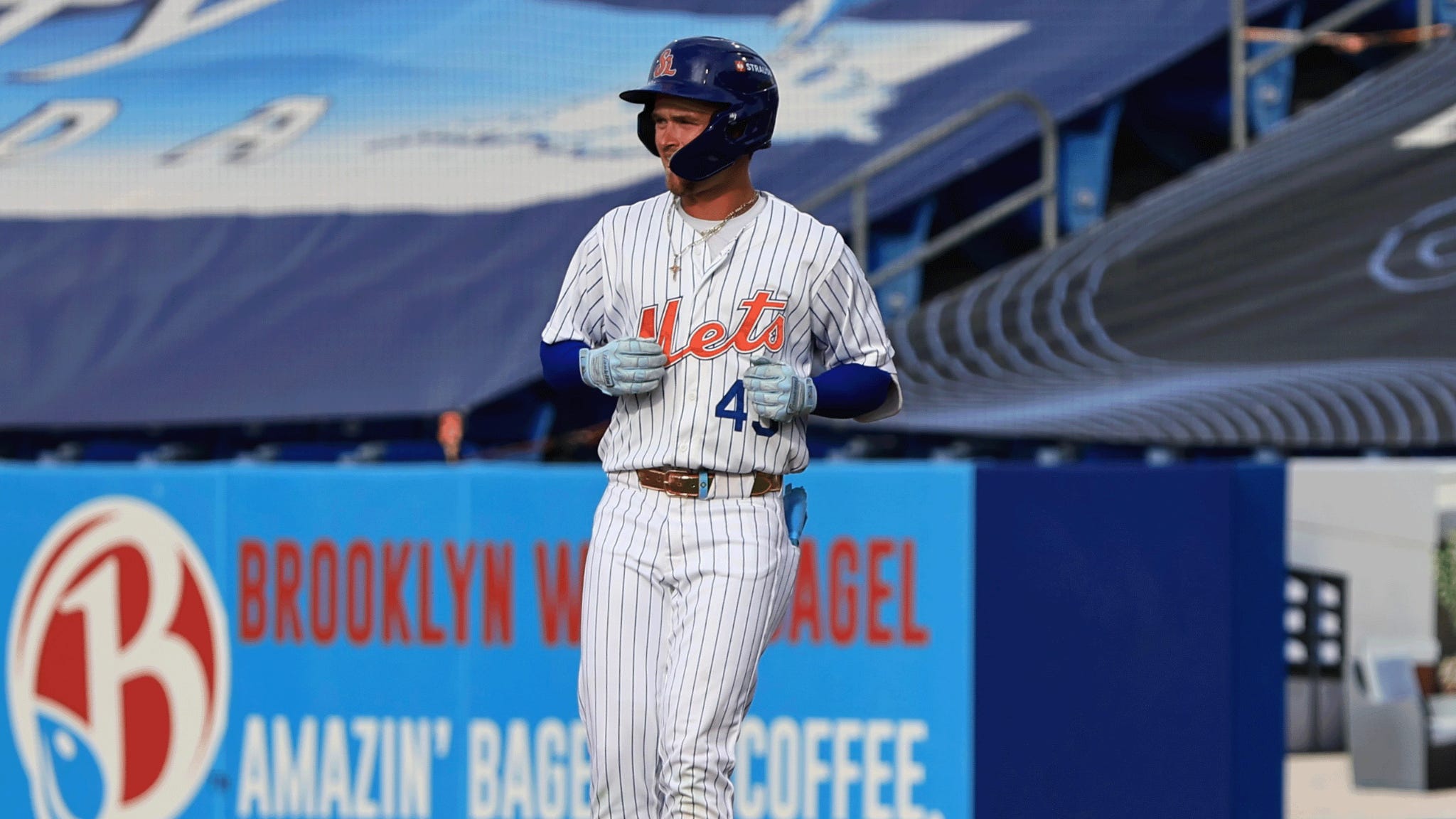
Trey Snyder is a little different from the other hitters on this list, which is why I watched his name like a hawk all season long. Snyder was drafted by the Mets out of Missouri’s Liberty North High School in the fourth round of the 2024 Draft, taking a shot on a young infielder whose polish and all-around tools stood out among the high-school class (*cough* A.J. Ewing *cough*).
To be clear, I’m not saying Snyder’s a lock to be the next A.J.-level success story, but the style of his game should complement Ewing’s and Carson Benge’s quite well. His offensive approach is built exclusively around contact and speed rather than raw power, as is reflected in his plate output in 2026. Over 75 games and three levels, he hit .289/.348/.388 with four home runs and 28 stolen bases. His best stretch came at Single-A, where he hit .306/.358/.435 in 36 games before moving up to Brooklyn. The production dipped a bit at High-A, where he hit .264/.324/.341, but he still stole 11 bases in 33 games. That paints a pretty clear picture of what Snyder can do when he’s on the field.
It goes without saying that Snyder needs to build up his power production if he’s going to make any big league waves. His .077 ISO in Brooklyn shows how little extra-base damage he was producing at that level, and the next step is finding a way to drive the ball more consistently without sacrificing his contact skills. His speed and defensive versatility give him a solid foundation for the organization to build upon, though, and if the bat can develop into something serviceable, Snyder might be primed for a breakthrough with a full, healthy campaign.
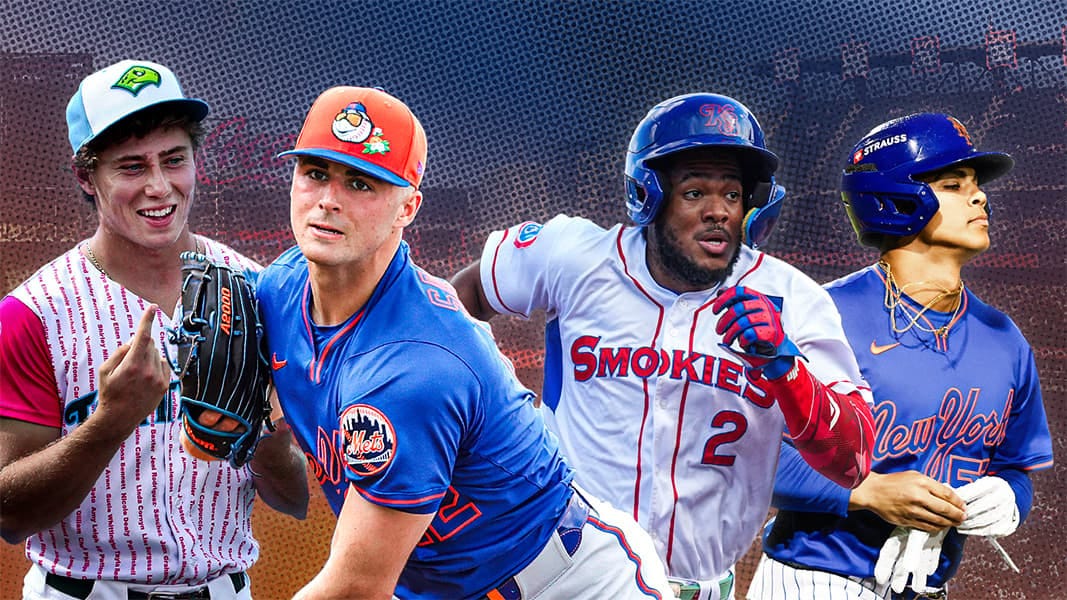
The Mets’ farm system entered 2026 as one of the lowest-ranked in baseball; after the trade deadline and a group of particularly strong second-half performances across levels, their prognosis entering 2027 appears positive.
With position players and pop-potential bats in the upper levels and what looks like a wealth of pitching in the lower levels (more on that in a few days), a timeline and pathway towards the next era of a David Stearns-built franchise is beginning to materialize. Though he deserves no credit for the Brewers’ run to the World Series, his fingerprints are still all over that roster: over half the pennant-clinching team was originally drafted, signed, or acquired via trade by Stearns during his eight-year tenure in Milwaukee. Building a true contender takes time, and it happens at all levels.
After the Dodgers were sold to the Guggenheim group in 2012, it took them eight years to win their first championship under new ownership. (Granted, that period also saw Andrew Friedman's installation as the new PoBo…but let’s not get distracted.) The Mets are entering year seven of the Steven Cohen era, and year four of the Stearns era. Despite the team’s first last-place finish since 2003, they managed to replenish a severely depleted, top-heavy farm at the trade deadline with talent that largely immediately performed well. The organization also demonstrated that the roots of a successful development/training pipeline are in place, in several ways:
Carson Benge and Nolan McLean both started their seasons on the Opening Day roster and turned in award-worthy performances in their first full MLB campaigns;
There were plus-value performances at the plate, in the field, and on the mound from a multitude of later-season rookie call-ups;
They were able to successfully deploy two completely different bullpens, in each half of the season, the latter of which was helmed by two guys coming back from elbow surgery and — huh, wouldn’t you know it — a rookie.
Oh, and Mets rookies posted the most valuable season of any class in team history, with roughly 14.0 total bWAR shared by five players.
Perhaps all is…NOT lost?
As cliché as it may be, it is true that good things take time, and they often prove to be worth the wait, as annoying as that wait may be. Mets fans have obviously been waiting a very, very long time, and there aren’t a ton of good things to remember from last year to distract ourselves with as we head towards an inevitable lockout.
But if exciting prospects keep making good on their potential, I suppose there are worse ways to wait out the trophy drought.